

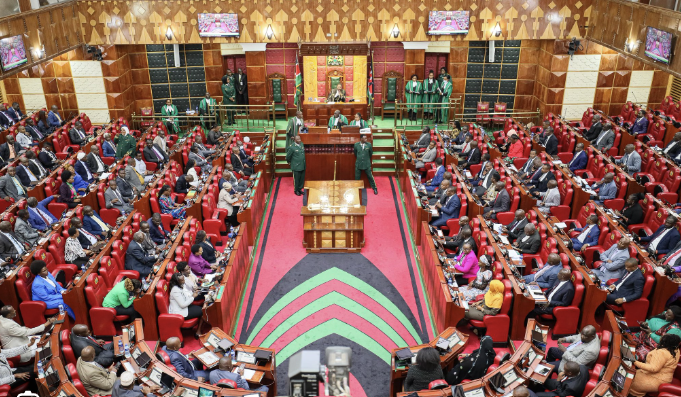
A major constitutional confrontation is brewing in Parliament as a key legislative committee demands urgent legal and financial clarity regarding the massive funding of bursary and scholarship programs by county governments. The inquiry, spearheaded by the National Assembly Departmental Committee on Regional Development, has cast doubt on whether counties are bypassing constitutional mandates by financing education support programs.
The controversy stems from disclosures by the Intergovernmental Relations Technical Committee (IGRTC), which revealed that 34 county governments have entered into formal agreements with the Ministry of Education to maintain these bursary schemes. While the IGRTC insists these partnerships are anchored in the Constitution’s spirit of cooperation, lawmakers remain unconvinced.
“If education support is a function, then resources must follow that function,” argued Committee Chairperson Peter Lokachapong during sessions held in Mombasa. He questioned the legality of counties allocating public resources to secondary and university-level education support, programs traditionally categorized as social protection rather than clearly devolved functions.
The debate has exposed a deep rift within the legislative branch. Some MPs, including Emurua Dikirr’s David Kipsang Keter, have called for a compulsory legal framework to prevent learners from being stranded if counties opt out of these agreements. However, others, like Matungu MP Oscar Nabulindo, have issued stern warnings against “alternative interpretations” of the law. Nabulindo pointed to clear guidance from the Controller of Budget, which has previously categorized education support as a primary national government function.
The uncertainty is further complicated by the current fiscal environment, where the national government is grappling with a projected KSh200 billion revenue shortfall. Skeptics argue that these intergovernmental partnership agreements are being used to circumvent constitutional safeguards, effectively legitimizing expenditures that may lack proper legal backing.
In response to the growing stalemate, a Legal Sector Working Group—bringing together Parliament, the Office of the Attorney General, the National Treasury, and the Kenya Law Reform Commission—is now tasked with developing a unified framework. Until this clarity is achieved, the future of thousands of scholarships across the country remains in a state of precarious limbo.









Leave a Reply