

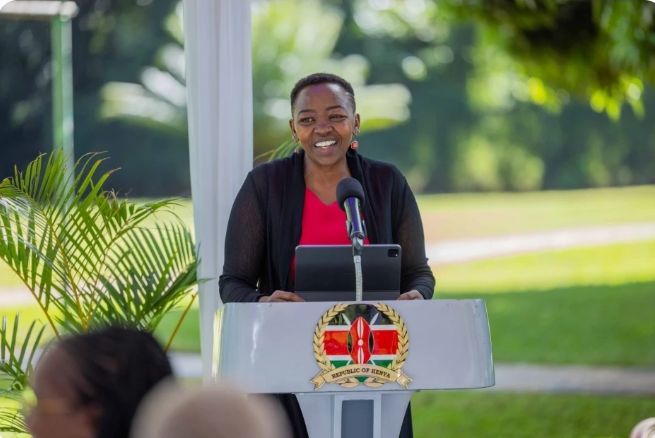
Kenya’s First Lady, Rachel Ruto, who recently concluded her tour of the USA at the invitation of US First Lady Melania Trump, recently sparked controversy with her remarks about State House overnight prayers (keshas), the effectiveness of national prayers and the state of food security in Kenya.
In a one-on-one interview, Rachel Ruto told America’s CBN News that Kenya depends on rainfed agriculture, making
She further stated that when it does not rain, it poses a major challenge to the country.
The First Lady recalled that soon after President Ruto’s inauguration, the country underwent a biting drought, prompting responses from the government and also the need for divine intervention.
Mrs. Ruto went on to say that, after holding a massive prayer rally in Nairobi on February 14, 2023, it only took a month before rains began to pour and the situation has reportedly continued since then.
“When my husband became president in 2022, it was a time when the nation was experiencing a very severe drought. Everyone did not know what to do, the church was praying and the government was giving out food. On February 14 2023, we held prayers at one of the biggest stadiums. We prayed and repented to God and asked Him to give us rain and food. Exactly one month later, rains started falling and it has not stopped since. Now we have food secure,” Rachel Ruto stated.
In her argument, the First Lady claimed that Kenya is now food secure, despite occasional short dry spells across different regions.
At the same interview, Mama Rachel further revealed that prayers at State House were ongoing, with people conducting intercessions in various locations, including public parks.
Additionally, she pointed out that overnight prayers, called keshas, are held every Friday at the State House and attributed the ongoing rains to these spiritual activities.
“Sometimes you’re walking, and you see in the parks, you know, groups, you know, meeting and just praying. People have overnight prayers, like even in State House. We have overnight prayers every Friday in State House,” she said.
She also linked the country’s economic progress to its Christian values, arguing that putting God at the centre of governance has been key.
“I think it is because of the love of God. For a nation to prosper economically, they really have to put God at the centre of everything,” she said.
Referencing 2024 Uganda’s East African revival in the 1930s, she predicted continuous rains and claimed that fertiliser would no longer be needed for planting crops in the country in the future.
While claiming that a revival had come to Kenya, the First Lady recalled a personal experience in May 2022, when she prayed for impure borehole water at their residence while William Ruto was still deputy president, and the water reportedly became clean.
The President’s spouse’s claims were immediately met with backlash and condemnation from a majority of Kenyans who called her out for the blatant lies and the obviously fabricated results of ‘national prayers’.
Daniel Ngugi wrote on X: “A NATIONAL DISGRACE! Lying on an INTERNATIONAL platform? Do Kenyans still expect such thoughts to lead them to Singapore? Also, can’t the American media do their simple research and tell that Kenya is currently undergoing a severe drought? Shameless!”
Someone else wrote, “This is clearly a lying family. They can’t help themselves. How can you sit at a Christian broadcast channel and churn out so much lies? Millions of Kenyans experienced drought throughout January and February. In fact, they still are to date! She thinks Nairobi rains are farming rains… “
On his part, Derrick Jomo said, “When leaders attribute environmental disasters to “sin” or a lack of repentance, they effectively shift the burden of responsibility from the state to the heavens
Drought in Kenya is not a supernatural phenomenon! By framing it as a spiritual test, the government risks absolving itself of its constitutional duty to ensure food and water security for its citizens.”
“Faith without work is dead. Prayer does not build dams, it does not drill boreholes, and it does not develop drought-resistant crop varieties. Kenya’s drought is a technical, environmental, and economic challenge that requires data-driven solutions, not meaningless ‘Keshas’,” Damaris Wafula wrote.
Kenya experienced severe drought at the start of 2026, particularly in the Arid and Semi-Arid Lands (ASALs), following two consecutive failed short-rain seasons in 2024 and 2025.
The government, through the National Drought Management Authority (NDMA), placed several ASAL counties in the drought “alert” and “alarm” phases, prompting coordinated relief efforts, including food distribution, water trucking, livestock feed support, and medical nutrition interventions.
According to NDMA, agencies reported that over 3.5 million people required emergency food assistance in early 2026, up from 2.2 million in 2025.
The government requested approximately Ksh.13 billion to address the food security and water crisis response.
County leaders, including Ahmed Abdullahi, the Wajir County governor, urged President William Ruto to declare the drought a national disaster, citing the need for larger-scale national and international funding to accelerate relief operation




Leave a Reply