

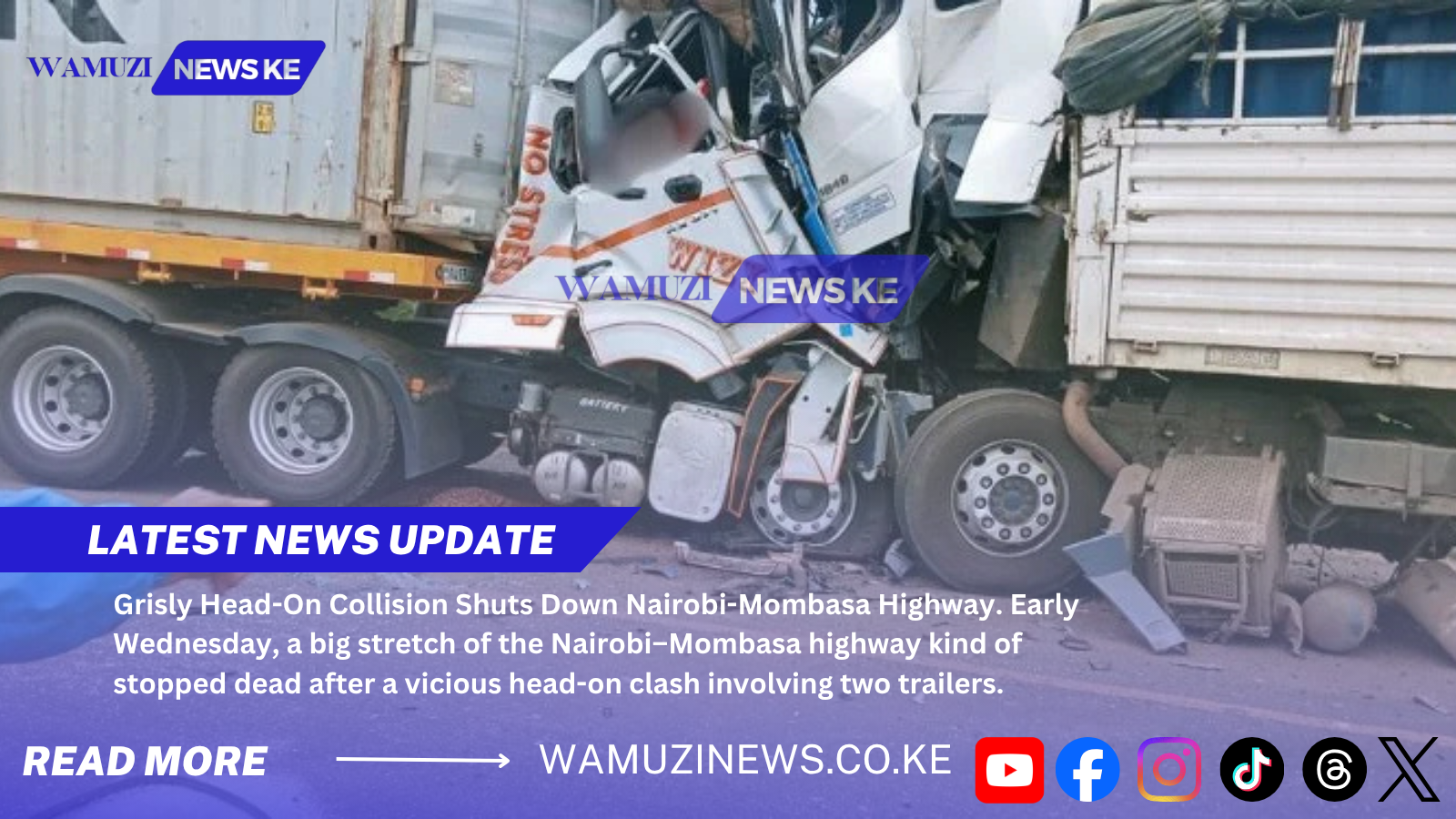
Early Wednesday, a big stretch of the Nairobi–Mombasa highway kind of stopped dead after a vicious head-on clash involving two trailers.
The incident happened around Salama area, and it has once more brought up, those very real worries about road safety levels, plus the constant risk that comes with heavy commercial vehicles on one of Kenya’s most used economic routes, you know the kind.
LoDCCA, the Long-Distance Drivers and Conductors Association, confirmed what happened, calling it a “terrible head-on collision.” They said it took place inside a clearly marked no-overtaking zone, which just adds to the anger.
People who were there told reporters that a blue shipping container hauler and a white trailer hit each other hard, so both vehicles were left disabled across the lanes. As a result, traffic was paralyzed in both directions, and it stayed that way for a while.
From the crash site, videos and photos showed wreckage, shattered glass, and mangled metal strewn on the tarmac. Residents and drivers gathered quickly while emergency responders tried to untangle the huge snarl-up created by the blockage.
Even though the official casualty figures are still being handled by the authorities, the force of the impact has already triggered concerns about deaths and serious injuries.
And honestly, this doesn’t look like a one-off thing. It is more like the newest chapter in a worrying line of accidents along the Salama–Sultan Hamud corridor.
That stretch has, in many ways, turned into a well-known black spot, with repeated crashes involving heavy trucks. Some of these incidents are often linked to reckless overtaking, and a neglect for road markings, especially the continuous yellow lines that are meant to stop exactly this kind of catastrophe.
“The highway is kind of a death trap,” remarked one regular commuter, sort of like, echoing that growing public sentiment that the present safety measures are not adequate.
Advocates are now, intensifying their push for the expansion of major highways into dual carriageways, they argue that the existing setup cannot handle the volume and the speed of today’s long-distance freight.











Leave a Reply