

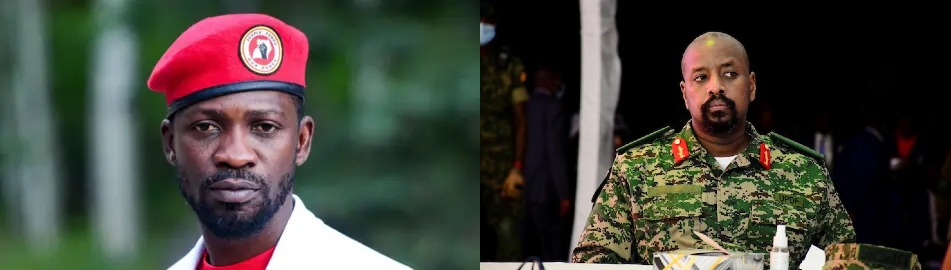
The confrontation has been dangerous politically, and Uganda is experiencing serious political repression and even the possibility of armed conflict due to the controversial presidential elections in 2026.
The powerful military commander General Muhoozi Kainerugaba has started the political controversy by launching an ultimatum at the so-called opposition leader Robert Kyagulanyi Ssentamu, popularly known as Bobi Wine, to surrender to the police within two days or be considered an “outlaw or rebel.” The declaration has raised the fear that the political situation will be worse with armed confrontations.
General Muhoozi Kainerugaba, son of President Yoweri Museveni and the top military figure, has called the so-called opposition leader “Kabobi” and has declared that Bobi Wine must give himself voluntarily to the authorities or he will be met with force at his residence.
The general has also tried to create a gap between the president’s official position and the government’s by implying that it was just an order from him and that he had “absolved” President Museveni from responsibility for giving the order.
Bobi Wine was rebellious in his response, claiming that Muhoozi planned a military-led operation to break into his home at Magere under the pretext of cutting power, disabling surveillance cameras, and deploying aircraft—these claims were supported by independent sources that described the operation as chaotic.
He flatly refused the demand for his surrender and maintained that he would come out when it was convenient for him, and he called the army “the perpetrators of atrocities against the people of Uganda.”
The developing conflict is taking place at the same time as a global and national debate about Uganda’s elections, which were held earlier this month and won by Museveni for a seventh time with over 70% of the votes. Bobi Wine and his National Unity Platform (NUP) have denounced the results as “fake” and caused by alleged ballot manipulation, voter intimidation, and security force interference.
Human rights organizations and political experts have alerted the authorities to the risk of an open call by the military chief for the arrest of an opposition leader being a dangerous precedent that mixes up the civil and military courts. The critics assert that the ultimatum has the potential to lead to a conflict and negatively impact the democratic principles that prevail in a country already divided politically.


Leave a Reply