

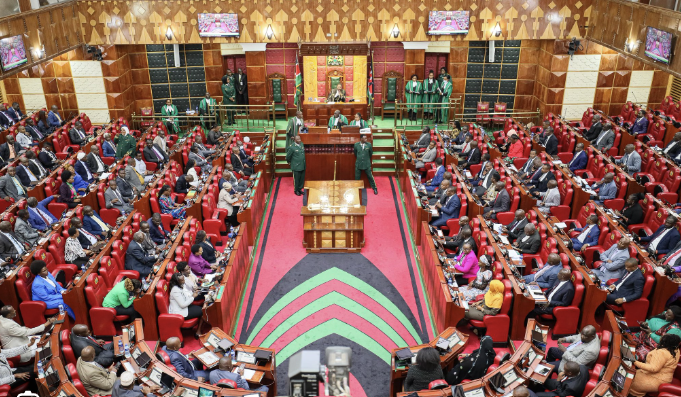
The National Assembly has released a very critical report that has brought about a political crisis; the report has disclosed that more than one office, which is of high-ranking government, has emptied nearly the whole of their annual budget, though having almost nothing to show for such enormous spending.
The parliamentary review, which spanned the first half of the current fiscal year, portrays a very sad scenario of fiscal irresponsibility in which billions of taxpayer shillings have gone to administrative expenses while necessary development projects remain on ice.
The audit carried out by the House Budget and Appropriations Committee points out, among others, the important state departments and executive offices that have so far used over 80 percent of their allotted funds. In a very surprising turn of events, the review has shown that despite the money being spent, the so-called “implementation rate” for the public services that were promised is extremely low at 10 percent or even less in the areas most affected.
With the legislative findings as support, the gap between the projected and actual service delivery hints at a very pervasive ailing system where the diverted resources are still going towards the “recurrent expenditures”—among them are luxury travel, hospitality, and consultancy fees—instead of the capital projects that are meant to energize the economy.
The report makes it very clear that the Treasury has been giving in a lot to the high-profile offices in the form of funds release, but, unfortunately, the benefit to the Kenyan taxpayer has been very small.
The estoppel clamoring for this revelation happened to be the immediate effect of the administration’s policies promoting fiscal restraint and discipline. The committee’s findings are coming to light just when the cross-town motorists are claiming it is easier to navigate through their tight spaces due to the fiscal discipline imposed upon them.
“‘We’re at a point where the tanks are empty, and yet the car has not budged a bit,” an anonymous senior Budget Committee member voiced. “We have nearly 100 percent of the administrative overhead expense accepted, and on the ground, the work is totally invisible.”
Parliamentary scrutiny warns that this “spending without results” phenomenon is generating a gigantic funding gap for the coming six months. With almost all budgets consumed, the departments that are critically important for government functioning are already on the edge of total operational shutdown unless a supplementary budget is passed—the passing of which would require more borrowing or increased taxes.
Economists caution that this practice of “front-loading” administrative costs is a major factor contributing to the national deficit. What the audited offices are doing is that they are prioritizing comfort and transport of state officials over the completion of projects and have thereby totally depleted the national budget from the inside.
While the report goes to the floor of the House for a full debate, Members of Parliament are going to push for a forensic audit of particular line items. The National Treasury is accumulating the pressure to clarify its position on why it kept on disbursing funds to the departments that perpetually fell short of their performance targets.










Leave a Reply