

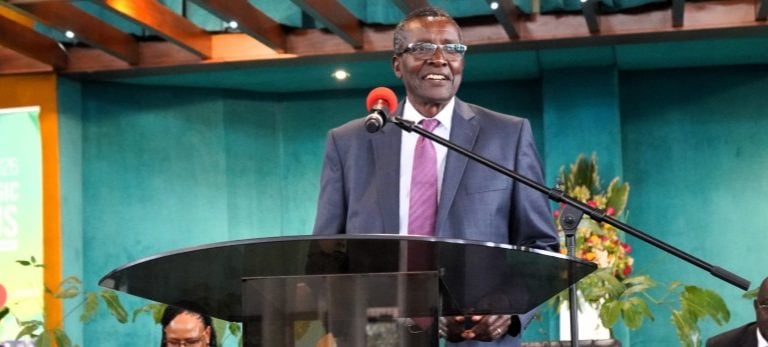
The former Chief Justice David Maraga has presented a very strong critical view of the economic situation in Kenya under President William Ruto. He claims that the country’s recent economic gains are being taken away from the ordinary people and are instead going to the political insiders and business cronies.
The remarks of Maraga are interpreted as an indication of the concern of the senior public figures about the huge disparities and elite capture as the national debates over the economic management and governance are still going on.
Maraga spoke to a big audience consisting of civil society groups and policy analysts and argued that the government has been boasting about the good performance of the economy through the stability of inflation and negotiation of debt repayment, and such macroeconomic indicators are the success stories of the government, but in fact, these improvements, if any, have not reached the everyday lives of most citizens. Rather, he implied, the rewards of Kenya’s economic growth are being extended to a small group of people who are politically connected.“The economy is working for Ruto and his cronies,” is what Maraga said, and this statement clearly reflected his assessment of the wealth distribution that is mainly tilted in favor of the elite as well as the elite’s perceived advantage.
He further argued that the measures that were supposed to bring about a growth in the economy were actually tailored for the benefit of the privileged ones who are in power and have the resources, and thus the existing situation has strengthened the rule of influence rather than competition or merit in determining who reaps the most from national economic activity.Maraga conceded to the fact that there had been some structural improvements, but he insisted that their effects were still not concrete to a large part of the populace.
He further stated that “when people cannot even afford to buy the most basic of goods, have no reliable job security, and do not see any chances of getting ahead in life, then the numbers reported are not of much significance.” His statement was in line with the views of the activists and critics who argued that the narratives of economy that have a macro point of view must be rooted in citizen experience rather than in statistical optimism.
Moreover, the former Chief Justice pointed out the issue of lack of transparency in the government’s contracts and procurement processes. According to him, the economic decision-making process has often been influenced by relationships rather than the public interest. Hence, he called for governments to be more accountable and to put in place reforms that prioritize equity and access instead of granting privileges to insiders.On their part, the administration’s allies make light of such categorizations by highlighting the economic indicators, which show that the country has gotten back from the pandemic shocks and that investment attraction has been one of the government’s efforts.
Government officials assert that economic policy must cope with the short-term difficulties while securing the long-term stability and that, in competitive markets, some level of elite involvement in the growth process is unavoidable.However, Maraga’s remarks contribute a significant voice to the discussions concerning the economic path of Kenya, especially as the political strain rises along with the coming elections.
His criticism has, in the view of many observers, brought to the fore the broader issue of who the real beneficiaries are when a country’s economy grows.It remains to be seen whether his caution will lead to a reevaluation of policy or it will just become opposition rhetoric. This will depend on how the leaders react to the increasing public scrutiny and the call for inclusive prosperity.













Leave a Reply