

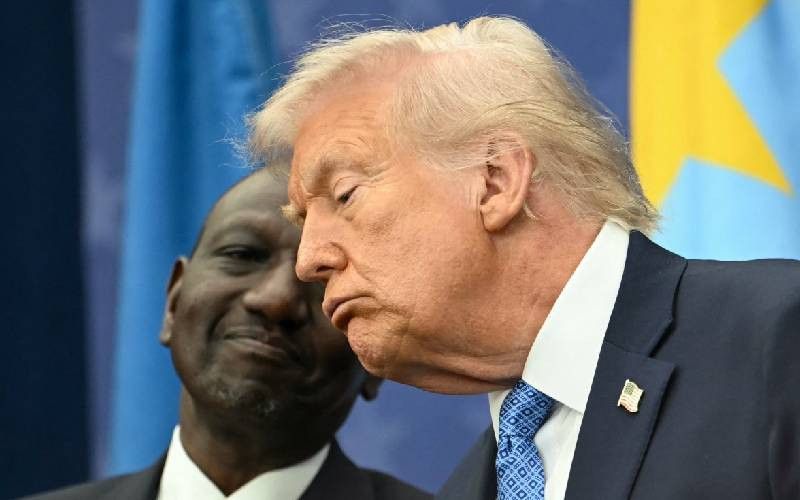
Surprisingly, Kenya has managed to survive the whole series of restrictive policies from the United States that were under President Donald Trump and has even surpassed the predictions of economic damage and diplomatic isolation, as Washington tightens up immigration and aid conditions that are directed at developing countries.
Analysts are now referring to Kenya’s resilience as a geopolitical anomaly, which raises questions about the changing of the global alliances and the strategic adaptability of the East African nation.
Initially, international observers had predicted that Kenya would be the major loser of Trump’s reimposition of the immigration controls, which resulted in a halt on visa processing for a number of African countries.
However, the capital city, Nairobi, was not on the ban list, which came as a surprise to the policy experts and gave instant relief to the prospective migrants and diaspora families that relied on the U.S. for work and residence.
The exclusion took place during a very politically delicate time: President William Ruto’s recent trip to Washington, where he had high-level engagement with his U.S. counterparts. The Kenyan officials have attributed the diplomatic outreach and the continued security cooperation with the U.S. as the factors that have allowed them to keep access to U.S. immigrant visa services in spite of the wider retrenchment in policy.
On the other hand, the fears that the foreign aid cuts during the Trump presidency, particularly through the United States Agency for International Development (USAID) and the Presidential Emergency Plan for AIDS Relief (PEPFAR), would bring the health sector in Kenya to its knees have not completely come true.
According to government sources, the strategies for financing domestic health and the diversification of donors have lessened the impact, and thus, the U.S. funds are no longer critical even if the situation of some crucial programs is still uncertain.
Analysts on both sides of the debate, both in trade and diplomatic circles, believe that Kenya’s resilience is the result of a very conscious and strategic foreign policy reshuffle. Over the period of the last two years, Nairobi has made stronger ties not only with China but also with regional partners in the trade area, thus securing Western support that has been more traditional but is still coming along with the new economic alliances that are opening up markets and flowing money around.
Nevertheless, there are critics who think that resilience might cover up the weak points of the system. The U.S. visa regulations, which are very strict, and the aid, which is being restructured, have been and continue to be the sources of huge uncertainty for those sectors that mainly rely on outside funding and overseas workers’ presence. There is a demand for deeper economic self-sufficiency and institutional reforms in Kenya to guarantee long-term stability regardless of the changing political environment.
Major global changes are taking place, and the ability of Kenya to avoid and handle the complexities of the geopolitical situation will be an important factor to consider for investors, diaspora people, and regional countries. The situation will be very dynamic as the administration of Trump transforms its policies in the months leading up to the reviews by the U.S. Congress of trade, aid, and immigration policies.










Leave a Reply