

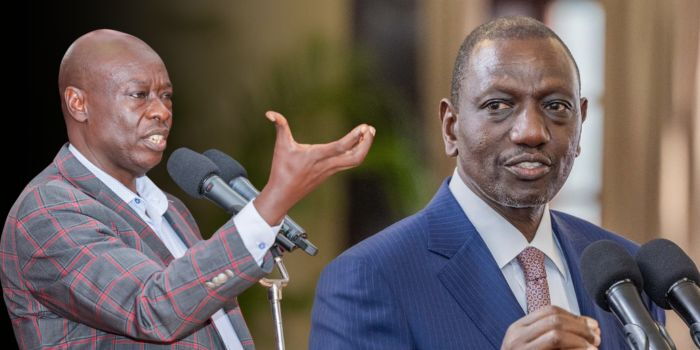
In a surprise and politically charged statement on Sunday, Rigathi Gachagua, the leader of the Democracy for Citizens Party, accused President William Ruto of taking advantage of the money, which is said to have been stolen in Minnesota, USA.
The accusation, which was made at a church service in AIPCA Kiratina in Komothai, Kiambu County, not only escalates the already heated disagreement between the two leaders but also raises new concerns over financial honesty and illegal activity crossing borders.
Gachagua claimed that money that was supposed to be used for helping disabled individuals in Minnesota was “stolen, brought to Kenya, and used for buying land, houses, and building a mall,” and that among the linked properties is a mall in Eastleigh, to which he pointed as a “beneficiary” of the suspect funds.
The allegations implicate a money laundering scheme that involved real estate and other investments in order to channel the proceeds into political or economic interests in Kenya, a charge that, if proven, would have significant legal consequences both domestically and internationally.
Gachagua did not present conclusive evidence during his speech, and his claims have not been validated by either of the countries’ law enforcement agencies.
At the time of the publication, President Ruto has not made any comment regarding the accusations, and it is still uncertain if the Kenyan government or the U.S. authorities have begun any formal investigations related to the allegations.
The observers stress that such accusations of linking high-ranking officials to worldwide fraud schemes might cause a serious diplomatic crisis, especially if the Minnesota authorities continue to investigate the asset transfer, which has been indicated through Gachagua’s statement.
Political experts argue that the accusation’s timing, which is just shortly before the 2027 general elections campaign’s momentum peak, would most likely escalate the party divisions and influence the voters’ views, particularly the ones in the already critical presidential constituencies.
They also warn that unproven claims of foreign fraud benefiting must be subjected to the most rigorous evidentiary standards in order not to erode public trust in political discussions.
Legal professionals predict that if any proof comes out tying public figures to alleged international fraud, it would result in intricate multi-jurisdictional investigations involving U.S. federal agencies and Kenyan law enforcement bodies, and that could even bring the issue to the level of a full-blown inquiry.
The political fallout is developing, and both the president’s supporters and detractors are preparing for a more vibrant discussion about corruption, governance, and accountability in the top government circles.








Leave a Reply