

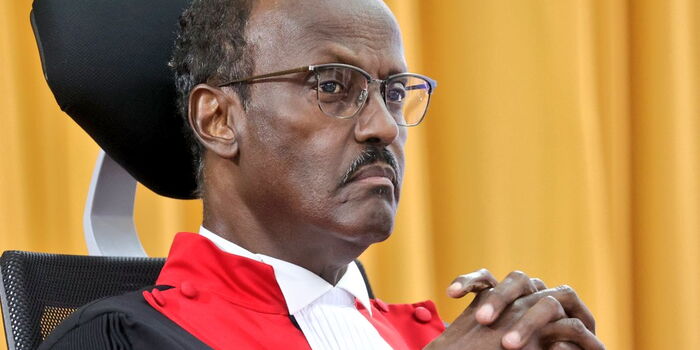
The sudden and shocking death of the Supreme Court Judge, Justice Mohammed Khadhar Ibrahim, has led the Kenyan Judiciary into deep mourning. The seasoned jurist, who has been a part of the country’s highest court since its establishment in 2011, died on the evening of Wednesday, December 17, 2025.
His death is particularly sad, as Justice Ibrahim was to retire officially from the Bench on January 1, 2026, when he turns 70, the mandatory retirement age.
He had already started organizing his leave, which would mark the closure of a legendary 23-year judicial career that took him from the High Court to the highest point of the legal system.
Justice Ibrahim was among the first judges of the Supreme Court. The appointment was done by former President Mwai Kibaki after a long and tough selection process. He was known for his gentle speaking manner and yet stubborn upholding of the law; thus, he played an important role in the development of Kenya’s post-2010 constitutional jurisprudence.
Before on the top court, Justice Ibrahim was there as a judge of the High Court starting from 2003. He had the reputation of being a very strong supporter of social justice and civil rights—thus, a good man but still a passionate defender of the law.
His fight for rights and justice began during the dark days of the pro-democracy struggle. In July 1990, just when he was the most vocal supporter of the direction that Kamiti Maximum Prison was taking, Ibrahim was arrested without a warrant, and his solitary confinement lasted a month.
Justice Ibrahim is distinguished among other Kenyans, being the first Kenyan-Somali community member to become the Advocate of the High Court of Kenya, which he did in January 1983. Moreover, he was a constant supporter of the rights of minority groups and the oppressed during his whole career, frequently depicting his state-sponsored discrimination experiences as his source of inspiration.
He was the Chairperson of the Judiciary Committee on Elections at the moment of his demise, and he was handling a situation where he built and fortified the foundations for electoral justice in the country. Furthermore, he was the Supreme Court representative in the Judicial Service Commission (JSC), and he was a very important person in the areas of judicial training and reform.
The unexpected death of Justice Ibrahim leads to an immediate opening at the Supreme Court, which is already undergoing a change since several senior judges are on the brink of retirement. Thus, his death has left the Supreme Court with one of its most brilliant and experienced judges exactly when the country is facing an important political and legal period.
The Chief Justice, Martha Koome, and the entire legal community will probably speak through formal tributes while the nation gets ready to say goodbye to a person who has been referred to as a “judge who never forgot the struggles of the vulnerable” by his colleagues.
The death of Justice Ibrahim is still confirmed with no cause of death officially stated; however, a sense of urgency can be felt in the courtrooms. What should have been a transition from active service to retirement for Justice Ibrahim in just fourteen days, marked by mourning rather than celebration, has instead turned into a national moment of grief.










Leave a Reply