
Siaya governor questioned the basis of fuel price hike calling on Epra to publish full Cost of Service Study
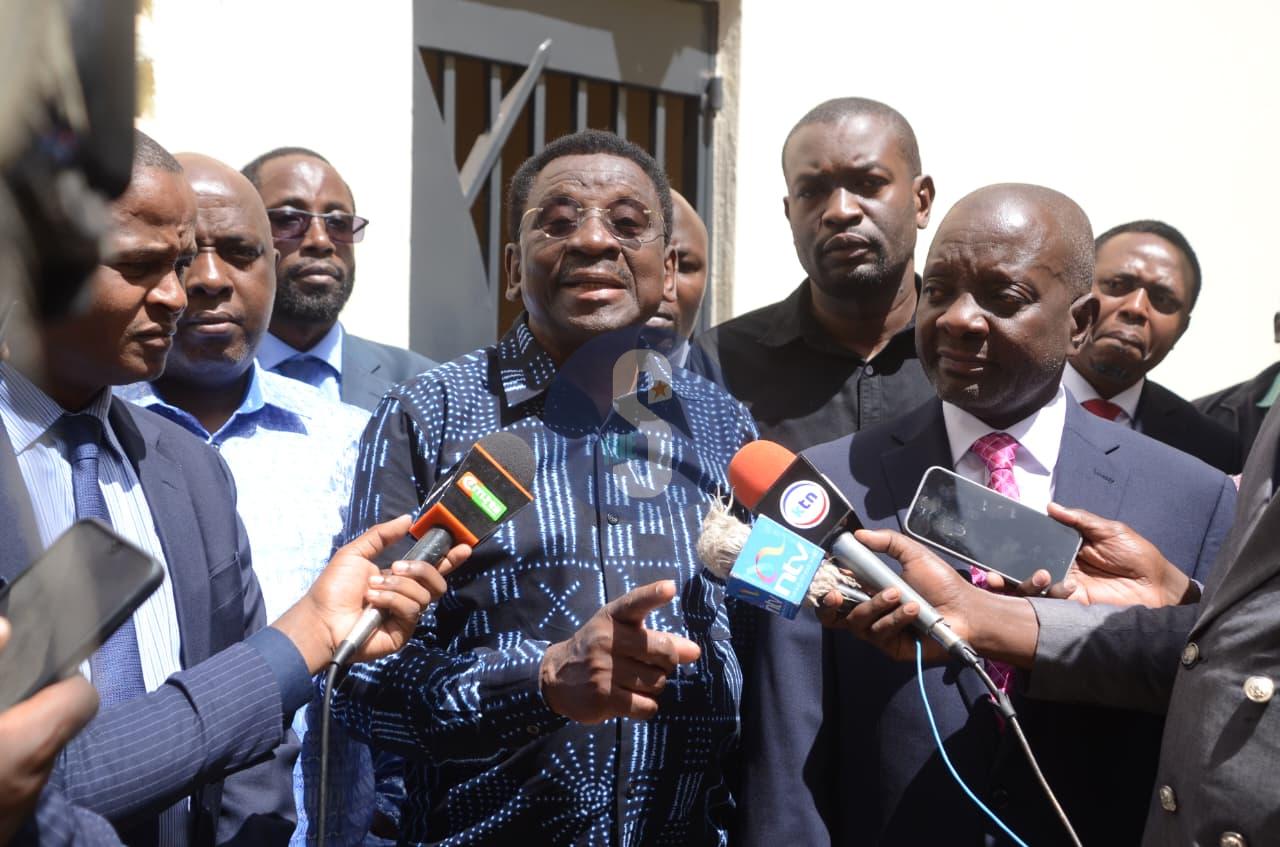
Siaya Governor James Orengo addressing journalists while accompanied by Vihiga senator Godfrey Osotsi, Nairobi Senator Edwin Sifuna together with other members of the Linda Mwanachi brigade outside the DCI offices in Parliament to record a statement on the recent attack.
Siaya Governor James Orengo has sharply criticised the latest fuel price increases announced by the Energy and Petroleum Regulatory Authority (EPRA), demanding full transparency on how the new costs were arrived at.
In a statement, Orengo accused the regulator of raising petroleum prices without adequate public explanation, warning that Kenyans are being burdened by decisions made “in total darkness.”
“The current economic landscape isn’t just a challenge; it’s a masterclass in gaslighting the Kenyan taxpayer. Yesterday, Epra didn’t just hike fuel prices; they insulted our collective intelligence,” Orengo said
“We are no longer just fuelling our cars; we are fueling a bloated, detached system where the maths simply refuses to add up because the variables are hidden from the public eye.”
His remarks came shortly after Epra announced new pump prices for the April to May 2026 cycle, ending weeks of speculation among motorists.
Under the revised pricing, the maximum allowed retail price for super petrol has increased by Sh28.69 per litre, while diesel has gone up by Sh40.30 per litre. The price of kerosene remains unchanged.
The adjustments are expected to have a ripple effect across the economy, with transport costs likely to rise and push up the prices of essential goods and services.
Orengo, however, questioned the basis of the increments, calling on Epra to immediately publish the full Cost of Service Study used to justify the new pricing structure. He argued that the phased margin revisions lack clarity and accountability.
“Epra must immediately publish the full Cost of Service Study and explain the rationale behind these phased margin revisions that are being implemented in total darkness,” he said.
Drawing comparisons with other sectors, the governor noted that electricity tariffs in Kenya typically undergo public participation and stakeholder engagement before implementation. He insisted that petroleum pricing—given its central role.
“If electricity tariffs require public participation and stakeholder input, then the lifeblood of our transport sector should not be managed behind closed doors,” Orengo added.
He further accused regulators of presiding over a system that disadvantages ordinary citizens while benefiting industry players with vested interests. According to Orengo, administrative price setting has failed to protect consumers and instead fuels inefficiencies and artificial inflation.
“We are being asked to fund a system that has completely forgotten the person on the ground,” he said.
“These ‘studies’ are often informed by industry players with vested interests, creating a cycle of artificial inflation that stifles efficiency.”
The governor proposed a shift toward a more liberalised and competitive petroleum market, arguing that competition, not centrally determined pricing, would better protect consumers from unjustified cost escalations.
“Kenya would be better served by abandoning this opaque pretense and restoring genuine competition to the petroleum market,” he stated. “Competitive pricing, rather than centrally determined margins, is the only way to drive efficiency and protect the public.”
Orengo also linked the price hike to growing public frustration over recent concerns about fuel quality, noting that motorists have been grappling with fears of contaminated or substandard fuel in the market.
“The frustration has reached a boiling point,” he said.
“After weeks of motorists playing Russian Roulette with contaminated ‘fake fuel’ and praying their engines wouldn’t knock, our reward for that anxiety is a higher bill at the pump.”







Leave a Reply